
Introduction
If you are serious about the air you breathe, choosing the right monitor is critical. In the search for the Best Indoor air quality monitors 2025, two names consistently rise to the top: the Airthings View Plus and the PurpleAir Zen. You might be torn between the comprehensive, all-in-one approach of the Airthings View Plus, which even detects radon, and the laser-focused precision of the PurpleAir Zen, which excels at measuring particles. While both devices promise to give you control over your environment, they serve very different masters. This comparison will break down exactly which monitor is the right fit for your specific health concerns and home setup, helping you decide where to invest your money this year.
Quick Comparison Overview
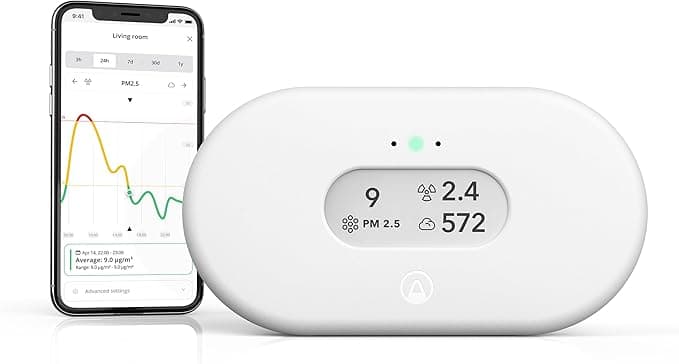
At a glance, the Airthings View Plus is the Swiss Army knife of air quality monitors, measuring seven factors including the dangerous gas radon. The PurpleAir Zen, on the other hand, is a specialist tool that uses dual lasers to provide the most accurate particulate matter (PM) readings on the market. The key difference is simple: choose the Airthings View Plus for a complete health picture, or choose the PurpleAir Zen if particle pollution (like smoke or dust) is your primary enemy.
Performance & Quality Comparison
When it comes to raw accuracy for specific pollutants, the PurpleAir Zen is in a league of its own. It utilizes dual laser particle counters to verify its data, ensuring that your PM2.5 and PM10 readings are highly reliable. This makes it an excellent choice for those living in wildfire-prone areas or near high-traffic zones. However, the PurpleAir Zen lacks sensors for volatile organic compounds (VOCs), carbon dioxide (CO2), or radon.
The Airthings View Plus takes a broader approach. It may not have a dual laser system, but it covers everything from humidity and temperature to the critical radon gas, which is the second leading cause of lung cancer. The trade-off is that while the Airthings View Plus is comprehensive, its particle detection is not quite as precise as the Zen's dedicated system. For overall health monitoring, the Airthings View Plus gives you a wider safety net.
Features & Functionality Comparison
The user experience differs significantly between these two monitors. The Airthings View Plus boasts an impressive battery life of up to two years, meaning you can place it anywhere without worrying about cables. It also offers deep smart home integration, allowing you to view your detailed app history and trigger automations. The downside is that its built-in screen only displays two metrics at a time, and users report that the USB port placement is awkward for constant power use.
The PurpleAir Zen is designed for instant visual feedback. It features a color-coded LED ring that changes from green to red based on your air quality, giving you a quick status check from across the room. This device works for both indoor and outdoor use, offering great versatility. However, it requires WiFi for full functionality and to access its detailed data, and it lacks the long battery life of the Airthings View Plus.
Price & Value Analysis
Price is a major factor when looking at the Best Indoor air quality monitors 2025. The Airthings View Plus sits at a higher price point, ranging from $329 to $349. You are paying a premium for the radon sensor and the long battery life. For the money, you get the most comprehensive sensor suite on the market, which justifies the cost if you have concerns about radon or want to monitor many variables.
The PurpleAir Zen is more affordable, typically priced between $229 and $270. While this is still higher than basic monitors, you are paying for professional-grade accuracy in particle detection. If you do not need VOC or CO2 monitoring, the PurpleAir Zen offers incredible value for the specific data it provides. However, the lack of a CO2 sensor might be a dealbreaker for those concerned about ventilation in bedrooms or offices.
Pros and Cons Side by Side
Airthings View Plus
- Pros: Measures 7 air quality factors including radon; Long battery life up to 2 years; Smart home compatible with detailed app.
- Cons: Higher price point than competitors; Screen only shows two metrics at once; USB port placement is awkward.
PurpleAir Zen
- Pros: Dual laser particle counters for high accuracy; Works for both indoor and outdoor use; Color-coded LED ring for quick status checks.
- Cons: No VOC or CO2 sensors; Requires WiFi for full functionality; Higher price than basic monitors.
Best Use Cases
Who should buy the Airthings View Plus?
You should choose the Airthings View Plus if you are a homeowner looking for a complete health solution. It is the best choice if you live in an area with known radon risks, or if you have a family and want to monitor VOCs from paint, furniture, or cleaning supplies. The long battery life is also ideal for renters who cannot hardwire devices or for those who want to move the monitor from room to room without hassle.
Who should buy the PurpleAir Zen?
The PurpleAir Zen is perfect for you if your primary concern is smoke, dust, or pollen. If you live in a region with seasonal wildfires or high particulate pollution, the dual laser accuracy of the PurpleAir Zen is unmatched. It is also a fantastic choice for outdoor monitoring, such as on a covered patio or in a garage, where you need to know the instant air quality status at a glance.
Final Verdict & Recommendation
Neither device is "better" than the other; they are optimized for different priorities. If you want the most comprehensive data set available in a single device, the Airthings View Plus is the clear winner. Its ability to detect radon is a unique and potentially life-saving feature that justifies its higher price. It is the best overall investment for general household health monitoring in 2025.
However, if you are specifically battling particle pollution and want the most accurate readings possible, the PurpleAir Zen is the superior tool. It is more affordable and provides faster, more visual feedback on the pollutants that matter most to you. To make the best choice for your needs, ask yourself one question: Do you need a broad health shield, or a sharp scalpel for particles? Your answer will determine which of these top-rated monitors from the Best Indoor air quality monitors 2025 list belongs in your home. Review your specific air quality concerns, and make your purchase with confidence.