First Alert RD1 Radon Test Kit - Best Budget Pick for Initial Screening
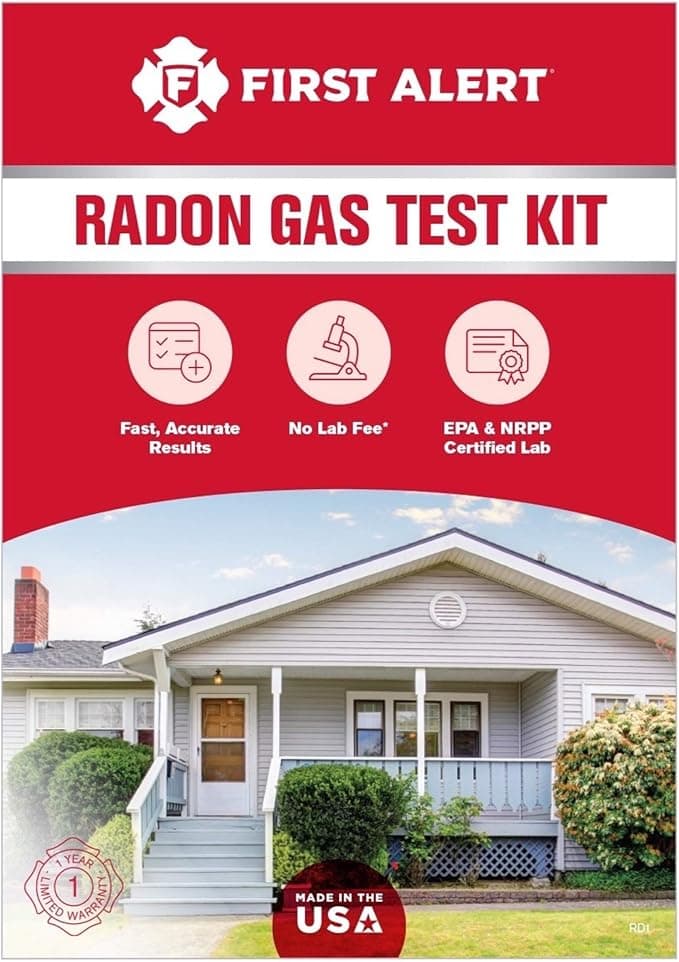
An affordable, disposable charcoal test kit ideal for first-time testing, real estate transactions, or as an initial screening tool before investing in a continuous monitor.
- +Extremely low cost provides an accessible entry point for initial radon testing in any home
- +Simple, passive operation requires no power or technical knowledge to set up and deploy
- +Includes laboratory analysis fees, with results typically delivered via email within a week of the lab receiving the kit
- -Only provides a short-term snapshot (2-4 days) which can be inaccurate due to daily radon fluctuations
- -Requires careful timing for mail-in and imposes a strict testing window (cannot exceed 7 days exposed)
- -Is a single-use product, offering no capability for continuous monitoring or long-term trend analysis
The First Alert RD1 Radon Test Kit serves a vital role as the most accessible and economical tool for initial radon screening. This passive, charcoal-based test kit is designed for simplicity: the user opens the sealed package, places the kit in the lowest lived-in level of the home for 2 to 4 days, then seals it and mails it to the included laboratory address for analysis. The cost covers the lab fees, and results are typically emailed within a few days of the lab's receipt. This makes it an ideal solution for several key situations. For home buyers and sellers, it provides a certified, lab-analyzed result that is often required or recommended during real estate transactions. For homeowners curious about potential radon but hesitant to invest in an electronic monitor, it offers a low-risk way to get an answer. It is also useful for conducting periodic checks in homes with existing mitigation systems, as recommended by the EPA.
However, its limitations are significant and important to understand. As a short-term test, it only captures radon levels over a few days. Radon concentrations fluctuate hourly and seasonally, meaning a short-term test can easily yield a false negative if conducted during a period of low radon activity, or a false positive during a temporary spike. It is not a tool for understanding long-term exposure averages. The testing process also requires strict adherence to timing guidelines, as the kit cannot be exposed for more than seven days and must reach the lab within a specific period to ensure accuracy. For definitive knowledge about year-round radon risk, a continuous monitor is necessary. Nevertheless, as an affordable first step that can trigger further action if high levels are detected, the First Alert RD1 performs its intended function effectively and remains a staple for basic radon awareness.