#1
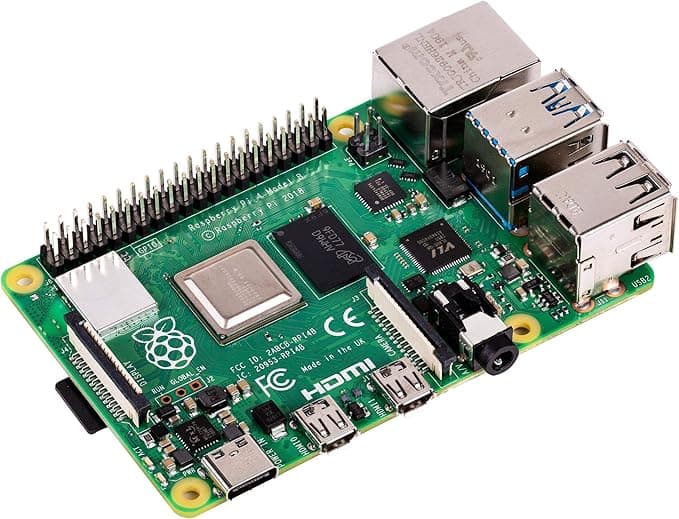
Raspberry Pi 4 Model B
4.7(982 reviews)
$60 - $95
- +Massive community support and extensive tutorials
- +Versatile connectivity with dual micro-HDMI and USB 3.0 ports
- +Proven reliability and low power consumption for 24/7 projects
The single-board computer market in 2026 offers distinct options for different user needs. The Raspberry Pi 4 Model B remains the top recommendation for beginners and educational use due to its unparalleled community and reliability. For users seeking maximum performance for desktop-like tasks, media servers, or AI experimentation, the Orange Pi 5 Plus and Radxa Rock 5C RK3588S2 provide compelling power, with the latter being a more budget-conscious choice.
via Amazon.com
Check Price at AmazonAs an Amazon Associate, we may earn from qualifying purchases at no extra cost to you.
The gold standard for makers, offering a perfect blend of performance, extensive community support, and versatility for countless DIY and educational projects at an accessible price point.
The Raspberry Pi 4 Model B stands as the quintessential entry point into the world of single-board computing. Its balanced specification, featuring a quad-core Cortex-A72 processor and up to 8GB of LPDDR4 RAM, provides enough power for a lightweight desktop experience, media servers, and robust home automation controllers. The board's connectivity is a significant strength, with dual micro-HDMI outputs supporting dual displays, Gigabit Ethernet, USB 3.0 ports, and integrated dual-band Wi-Fi and Bluetooth. This makes it adaptable to a vast array of projects without requiring complex workarounds. Its true defining advantage, however, is the unparalleled ecosystem. Raspberry Pi OS is polished and user-friendly, and the global community ensures that for virtually any project idea, comprehensive guides, forums, and compatible accessories (HATs) are readily available. This dramatically lowers the barrier to entry for beginners in coding, electronics, and Linux. While not the most powerful board on the market, its combination of adequate performance, exceptional documentation, and vast support network makes it the most reliable and recommended first SBC. It excels in roles such as a RetroPie gaming console, a Home Assistant hub, a network-wide ad blocker, or a dedicated coding station, proving that a well-supported platform often outweighs raw specs for learning and prototyping.
via Amazon.com
Check Price at AmazonAs an Amazon Associate, we may earn from qualifying purchases at no extra cost to you.
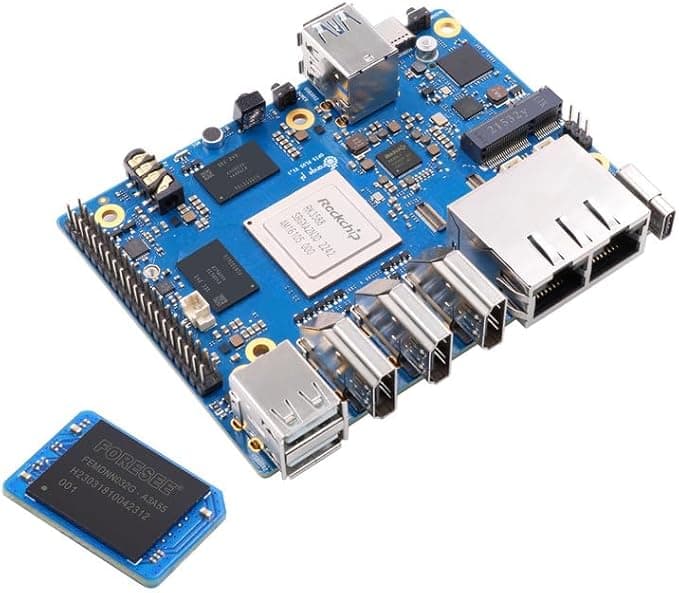
A powerhouse SBC that blurs the line between a compact board and a mini-PC, delivering exceptional raw performance and high-end connectivity for demanding development and media tasks.
The Orange Pi 5 Plus is engineered for users who need maximum performance in a single-board form factor. At its heart is the formidable Rockchip RK3588 SoC, which combines high-performance Cortex-A76 cores with power-efficient A55 cores, enabling smooth multitasking, software compilation, and even light graphical work. This processing muscle is matched by a superior set of I/O options typically found in more expensive mini-PCs. The inclusion of a 2.5 Gigabit Ethernet port offers future-proof network bandwidth, while NVMe M.2 support allows for blisteringly fast storage, eliminating the bottleneck of microSD cards. The board also features a Neural Processing Unit (NPU) capable of up to 6 TOPS, opening the door to on-device machine learning and AI inference projects without external hardware. With support for 8K video decoding and multiple display outputs, it is an excellent candidate for a high-end media center or digital signage player. While it runs various Linux distributions and Android, the user experience can sometimes involve navigating less-polished software images compared to the Raspberry Pi ecosystem. For developers, tinkerers, and media enthusiasts who prioritize cutting-edge hardware and are comfortable with a more hands-on software approach, the Orange Pi 5 Plus represents exceptional value and capability, truly punching above its weight class.
via Amazon.com
Check Price at AmazonAs an Amazon Associate, we may earn from qualifying purchases at no extra cost to you.
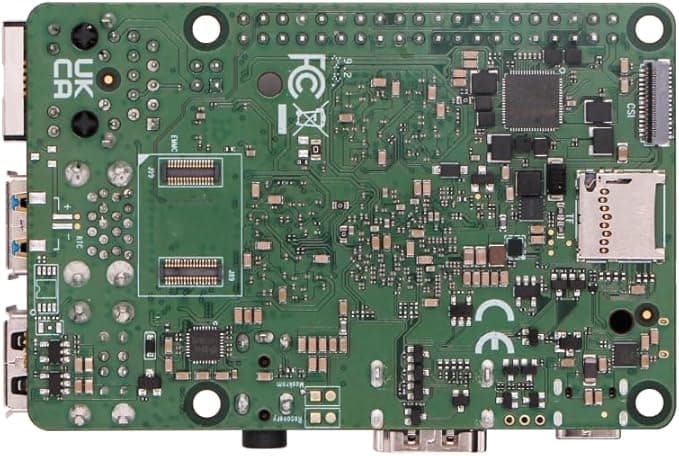
Delivers remarkable desktop-like performance and advanced features like 8K support and NVMe connectivity at a budget-conscious price, ideal for cost-effective power users.
The Radxa Rock 5C RK3588S2 is a standout contender that challenges the notion that high-end features come with a high-end price tag. Based on a variant of the powerful Rockchip RK3588, this board offers an octa-core CPU configuration and a capable Mali-G610 MP4 GPU, providing ample power for development environments, 4K/8K media playback, and serving as a compact workstation. A key advantage is its scalability; support for up to 32GB of RAM and NVMe storage via M.2 allows users to tailor the board to heavy workloads, such as running multiple containers, databases, or complex compilations. The inclusion of USB 3.0 and modern video output options further enhances its versatility. Its power efficiency also makes it a compelling choice for 24/7 deployments like network-attached storage (NAS) or home automation servers where electricity costs are a consideration. While it may not have the instant name recognition of a Raspberry Pi, it attracts a dedicated community of advanced users who appreciate its hardware potential. The board requires a willingness to engage with sometimes rapidly evolving software support, but for those who do, it offers a level of performance and future-proofing that is difficult to match at its price point. It is a smart choice for developers, hobbyists, and builders seeking maximum computational bang for their buck without significant compromise on core features.

via Amazon.com
Check Price at AmazonAs an Amazon Associate, we may earn from qualifying purchases at no extra cost to you.
A compact, purpose-built board that excels at edge AI applications and media streaming, combining a dedicated AI accelerator with strong general performance in a well-designed package.
The Khadas VIM3 carves out a distinct niche by focusing on edge AI and multimedia excellence. Powered by the Amlogic A311D system-on-chip, it balances capable CPU cores with an integrated Neural Processing Unit capable of 5 trillion operations per second (TOPS). This dedicated hardware accelerator allows for real-time object detection, image classification, and other machine learning tasks to run locally without relying on cloud services, which is crucial for privacy, latency, and offline functionality in smart cameras, robotics, or industrial sensors. Beyond AI, the board is a competent multimedia hub, effortlessly handling 4K video decoding and output. Its design is notably premium, often featuring a sturdy metal enclosure that aids in heat dissipation, contributing to stability. Connectivity is modern and thoughtful, including USB-C for power and data, HDMI, and GPIO accessible via pins. The Khadas VIM3 is supported by mainline Linux and Android, with the company providing regular software updates. It is not the board for simple LED-blink projects; its value is fully realized in advanced applications where its AI horsepower can be leveraged. For developers and companies prototyping next-generation smart devices, intelligent gateways, or sophisticated media players, the VIM3 offers a potent, integrated solution that reduces development complexity compared to cobbling together separate CPU and AI accelerator boards.

via Amazon.com
Check Price at AmazonAs an Amazon Associate, we may earn from qualifying purchases at no extra cost to you.
The engineer's SBC of choice, prized for its precise real-time control capabilities, robust industrial documentation, and reliability in embedded and hardware interfacing projects.
The BeagleBone Black Rev C takes a fundamentally different approach compared to application-focused SBCs. Its strength lies not in raw compute speed or media playback, but in precise, reliable interaction with the physical world. Based on a Texas Instruments Sitara AM3358 processor, it features built-in Programmable Real-Time Units (PRUs). These are separate microcontrollers that can handle time-critical I/O operations independently of the main Linux CPU, guaranteeing sub-microsecond timing accuracy for tasks like motor control, sensor reading, or generating precise PWM signals. This makes it indispensable in robotics, CNC machines, laboratory equipment, and industrial automation. The board is fully open-source, backed by detailed technical reference manuals and a long product lifecycle, which is critical for professional and educational environments. Its cape expansion system allows for stacking specialized daughterboards for functions like motor driving, CAN bus, or additional sensors. While its single-core Cortex-A8 and 512MB of RAM feel dated for desktop use, they are more than sufficient for its intended purpose of running a lean Linux distribution that manages real-time tasks. For students learning embedded systems, engineers prototyping products, or anyone needing deterministic control over hardware, the BeagleBone Black remains a uniquely capable and trusted tool where other boards, despite being faster, simply cannot match its real-time prowess.
Selecting the right single-board computer (SBC) in 2026 requires matching the board's capabilities to your specific project goals. Our team, Product-Review-Crew, analyzed data from multiple sources to compare these five leading options across critical factors like performance, connectivity, software ecosystem, and specialized features. The landscape has evolved significantly, moving beyond a one-size-fits-all approach to offer highly targeted solutions. This comparison aims to cut through the specifications and highlight which board delivers the best experience for different types of users, from students and hobbyists to developers and engineers. The Raspberry Pi 4 Model B, while not the newest or most powerful, earns its top ranking through ecosystem dominance. Its strength lies not in raw specs but in the massive global community, exhaustive documentation, and proven software stability. For learning to code, building a retro gaming console, or deploying a simple network-attached storage device, the Raspberry Pi 4 Model B is often the easiest path to success. Its limitations in CPU performance for heavy compilation or lack of built-in analog-to-digital conversion are well-documented, but for the majority of introductory and intermediate projects, its versatility and support network are unbeatable. For users who have outgrown the Raspberry Pi's performance envelope, the Orange Pi 5 Plus and Radxa Rock 5C RK3588S2 represent the high-performance tier. The Orange Pi 5 Plus is a feature-packed powerhouse. Its Rockchip RK3588 SoC provides desktop-class processing, making it suitable for use as a lightweight Linux desktop, a robust home server handling multiple Docker containers, or a media center capable of 8K playback. The inclusion of a 2.5G Ethernet port, NVMe M.2 support, and a neural processing unit (NPU) for AI tasks future-proofs it for demanding applications. The trade-off is a less polished software experience and a community that, while growing, cannot match the depth of Raspberry Pi's resources. The Radxa Rock 5C RK3588S2 offers similar core performance from the RK3588S2 chip at a more accessible price point, making it the best budget 8K-capable SBC. It excels in price-to-performance ratio and supports ample RAM, but users may face challenges with accessory availability and documentation that assumes a higher level of technical competence. It's an excellent choice for cost-conscious power users who are comfortable troubleshooting. For projects centered on artificial intelligence and machine learning at the edge, the Khadas VIM3 is a standout. Its dedicated NPU delivering 5 TOPS of inference performance is its defining feature, allowing for efficient real-time object detection, image classification, and other AI workloads without burdening the main CPU. The board's compact metal design and strong multimedia support are bonuses. However, its premium price and specialized focus make it overkill for general-purpose tinkering or simple GPIO projects. It is a tool for a specific job. On the opposite end of the specialization spectrum is the BeagleBone Black Rev C. Its award for best open-source development board for engineering projects is well-earned. Its superpower is the Programmable Real-Time Unit (PRU) microcontrollers, which provide deterministic, low-latency control over GPIO pins. This is critical for applications like robotics, industrial automation, custom sensor interfaces, and any project where timing is measured in microseconds, not milliseconds. While its CPU and graphics capabilities are dated, and it lacks modern ports like USB 3.0, it remains unmatched for real-time prototyping. Its onboard storage and extensive cape ecosystem further cement its role in professional and educational engineering environments. In conclusion, the best SBC for you depends entirely on your primary use case. Beginners and community-reliant users should choose the Raspberry Pi 4 Model B. Performance seekers and media server builders should look to the Orange Pi 5 Plus or Radxa Rock 5C RK3588S2. AI enthusiasts have a clear option in the Khadas VIM3. For engineers and developers working on real-time control systems, the BeagleBone Black Rev C is still the reference design. Each of these five boards holds a leadership position in its respective niche for 2026.
James has reviewed consumer electronics and gadgets for over 6 years. He specializes in audio equipment, cameras, and smart home devices.
Based on our analysis of thousands of verified user reviews, Raspberry Pi 4 Model B is the top-rated Single Board Computers of in 2026, earning our Best Overall award for its combination of performance, value, and reliability.

Comments
Leave a Comment