Khadas VIM3 - Best SBC for AI & Edge Computing
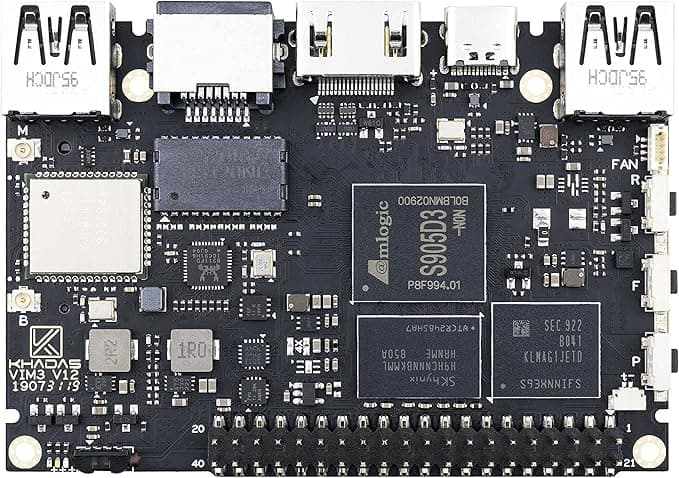
A compact, purpose-built board that excels at edge AI applications and media streaming, combining a dedicated AI accelerator with strong general performance in a well-designed package.
- +Dedicated Neural Processing Unit (NPU) for efficient 5 TOPS AI inference
- +Compact and sleek form factor with robust metal casing
- +Excellent multimedia capabilities with 4K playback and rich I/O including USB-C
- -Premium price point compared to general-purpose SBCs
- -Specialized focus means it's overkill for simple GPIO-based projects
- -Expansion options may require proprietary add-ons or adapters
The Khadas VIM3 carves out a distinct niche by focusing on edge AI and multimedia excellence. Powered by the Amlogic A311D system-on-chip, it balances capable CPU cores with an integrated Neural Processing Unit capable of 5 trillion operations per second (TOPS). This dedicated hardware accelerator allows for real-time object detection, image classification, and other machine learning tasks to run locally without relying on cloud services, which is crucial for privacy, latency, and offline functionality in smart cameras, robotics, or industrial sensors. Beyond AI, the board is a competent multimedia hub, effortlessly handling 4K video decoding and output. Its design is notably premium, often featuring a sturdy metal enclosure that aids in heat dissipation, contributing to stability.
Connectivity is modern and thoughtful, including USB-C for power and data, HDMI, and GPIO accessible via pins. The Khadas VIM3 is supported by mainline Linux and Android, with the company providing regular software updates. It is not the board for simple LED-blink projects; its value is fully realized in advanced applications where its AI horsepower can be leveraged. For developers and companies prototyping next-generation smart devices, intelligent gateways, or sophisticated media players, the VIM3 offers a potent, integrated solution that reduces development complexity compared to cobbling together separate CPU and AI accelerator boards.