Water leak detectors have evolved considerably beyond the basic battery-powered alarms that simply sound when water reaches the floor. Modern systems range from inexpensive wireless sensors designed to protect individual appliances to sophisticated whole-home monitors that analyze water flow and pressure, identify abnormal usage, and automatically shut off the main water supply. Choosing between these approaches depends largely on the level of protection required. A point sensor can cost only a few dollars and protect a washing machine or sink, while a whole-home system requires professional plumbing work but can potentially stop a major leak even when nobody is home.
In 2026, Product-Review-Crew evaluated five of the strongest water leak protection options available to U.S. homeowners, considering detection speed, connectivity, alarm functionality, smart-home compatibility, coverage, installation requirements, battery life, automatic shutoff capabilities, and overall value. Because these products serve very different purposes, the comparison includes both permanent whole-home water management systems and inexpensive wireless sensors that can be deployed throughout a property.
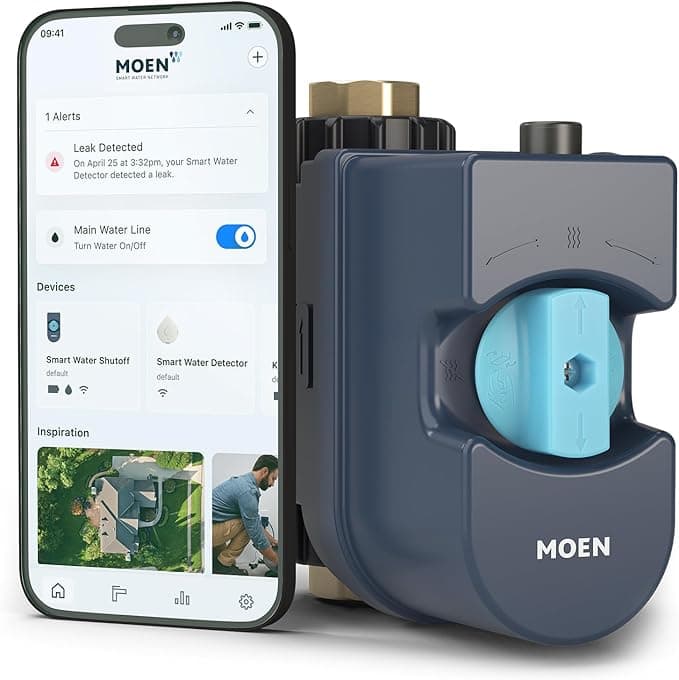
The Flo by Moen Smart Water Monitor and Shutoff takes the top position as the most comprehensive whole-home protection system. Installed directly on the main water line, Flo continuously analyzes water flow, pressure, and temperature to identify unusual patterns associated with leaks and abnormal consumption. When a serious leak is detected, the system can automatically shut off the home's water supply, potentially preventing a plumbing failure from causing extensive damage. The companion app also provides water consumption information and remote alerts, giving homeowners considerably more information than a conventional moisture sensor. The major drawback is installation cost and complexity, since the system normally requires professional plumbing work and continuous power and Wi-Fi. For homeowners primarily concerned with preventing catastrophic water damage, however, the combination of continuous monitoring and automatic shutoff makes Flo substantially more capable than a conventional leak alarm.
The Phyn Plus Smart Water Assistant + Shutoff provides a similar whole-home approach while putting particular emphasis on water pressure and plumbing analytics. Rather than waiting for water to reach a small sensor on the floor, Phyn monitors the home's plumbing system and analyzes flow and pressure changes that can indicate leaks or unusual consumption. The system can automatically shut off the water when a significant problem is detected, while the Phyn app provides information about household water usage and plumbing behavior. This makes it useful not only as an emergency protection device but also as a way to identify developing plumbing problems. Like Flo, Phyn Plus requires installation on the main water line and depends on electrical power and Wi-Fi for its connected functionality. Its higher cost means it is primarily suited to homeowners looking for permanent whole-home protection rather than inexpensive room-level monitoring.
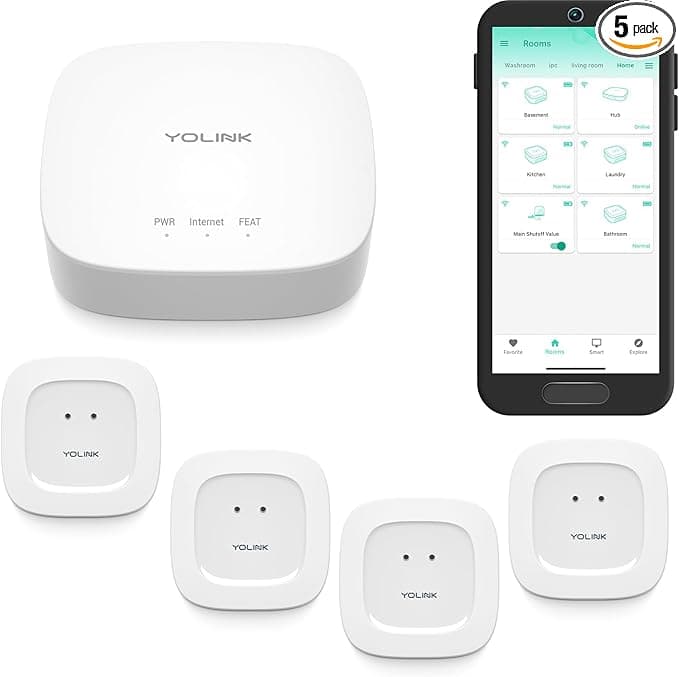
For large homes, detached buildings, garages, workshops, and other properties where conventional wireless sensors can struggle with range, the YoLink Smart Water Leak Sensor system takes a different approach. Its LoRa-based communication can connect sensors over much greater distances than typical Wi-Fi or Bluetooth systems, while a single hub can support a large number of sensors. This makes it possible to monitor many areas from one centralized system, including locations where Wi-Fi coverage is weak or unavailable. YoLink also offers specialized sensors for temperature, tank levels, sump pumps, and other applications, allowing the system to grow beyond basic leak detection. The primary limitation is the requirement for a hub and the additional configuration needed for some advanced automations. For properties where wireless range and the ability to deploy many sensors are the primary concerns, however, YoLink is particularly well suited.
The Aqara Water Leak Sensor T1 provides a much less expensive way to build room-by-room smart water protection. Its compact design allows sensors to be placed beneath sinks, near toilets, around washing machines, beside water heaters, and in other vulnerable areas without requiring professional installation. When paired with an Aqara hub, the T1 can send remote notifications and participate in smart-home automations. The low cost also makes it practical to deploy several sensors rather than trying to protect an entire property with one device. The trade-off is that the T1 only detects water where the sensor is physically located and cannot shut off the main water supply by itself. Homeowners wanting automatic shutoff need compatible additional hardware. Nevertheless, for smart-home users who want inexpensive sensors throughout the house, Aqara offers a compelling combination of small size, low cost, and automation potential.
The X-Sense SWS54 provides another straightforward approach for homeowners who prioritize affordable multi-room coverage. Instead of requiring plumbing modifications, the wireless sensors can simply be positioned in locations where leaks are most likely to occur. Local audible alarms provide immediate notification when water is detected, while the connected system can provide smartphone alerts when paired with the appropriate base station. This makes the SWS54 particularly suitable for renters, smaller properties, or homeowners who want additional protection around individual appliances without paying for a whole-home shutoff system. It lacks the flow analysis and automatic water shutoff offered by Flo and Phyn, and its smart features are less extensive than a fully developed home automation platform. Its strength is simplicity and the ability to cover multiple vulnerable locations at a relatively low cost.
The differences between these five systems highlight an important distinction when shopping for water leak protection. Whole-home systems such as Flo and Phyn monitor the plumbing itself and can potentially stop a major leak automatically, making them fundamentally different from conventional water sensors. YoLink occupies the middle ground by creating a large network of individual sensors with exceptional wireless range. Aqara and X-Sense are more affordable point-detection solutions that allow homeowners to protect several high-risk areas without modifying the home's plumbing.
The right choice therefore depends on the type of protection required. Homeowners primarily concerned about catastrophic water damage may want a professionally installed whole-home monitor with automatic shutoff. Those protecting a large property may benefit more from YoLink's long-range sensor network, while smart-home users can deploy inexpensive Aqara sensors across numerous rooms. X-Sense provides another affordable route to multi-location protection with strong local alarms. Regardless of the system selected, placing sensors near water heaters, washing machines, dishwashers, sinks, toilets, sump pumps, and other potential failure points can provide valuable early warning. For maximum protection, combining inexpensive point sensors with a whole-home automatic shutoff system can also provide multiple layers of defense against water damage.



Comments (7)
Is the 'Govee Wi-Fi Water Leak Detector' loud enough to hear from upstairs?
Yes, the siren is piercing. I heard it from the basement while sleeping on the second floor. The app notification is immediate too.
I use the 'Eve Water Guard' with HomeKit. Integrates seamlessly, but I wish the cable sensor was longer.
The 'YoLink' kit is amazing for my 5-acre property. The hub reaches the barn 300 ft away through walls. Great for remote well house monitoring.
The 'Moen Smart Water Detector' is foolproof. Just place it near the washer, and it screamed an alert when my hose leaked. Love the away mode notifications.
Leave a Comment